WEB_RAT Is Still Alive: Huntback Maps SalatStealer's Active Panel, Rotating C2, and TON Fallback
Huntback captured an active SalatStealer bootstrap on its apparent backend, while live TLS certificates connect the current WEB_RAT panels to the stealer's rotating C2 infrastructure. Newer builds add TON-based C2 recovery, allowing operators to replace seized or blocked servers without issuing another malware build.
On 16 October 2026, Huntback recovered what initially appeared to be an exposed config.json from 176.12.71[.]122. Its contents were not JSON. The response was a small JavaScript bootstrap that registered a service worker and redirected visitors into a WEB_RAT login flow.
Every IP, file and pivot below is in huntback right now. Open this host and walk the cluster yourself, or search the loot other operators left exposed.
The same server returned essentially the same page for .env. That changed the interpretation immediately. Huntback had not discovered two exposed configuration files; it had found a catch-all route on infrastructure associated with the operator-facing side of WEB_RAT.
WEB_RAT is not simply the name of a generic remote-administration panel. It is also the branding used by SalatStealer, a Go-based Windows information stealer offered through a malware-as-a-service model. SalatStealer steals browser credentials and sessions, targets cryptocurrency wallets and messaging applications, weakens endpoint protections, establishes persistence, and gives subscribers a web panel through which they can manage infected systems.[1][2]
Huntback's observation provided a fresh point from which to map the contemporary infrastructure. Passive DNS showed that the captured IP was tied to wruser[.]org. Live TLS certificates then connected that domain to salator[.]es, sa1atik[.]cn, and websalat[.]top. A separate certificate grouped four WEB_RAT panel domains on an OVH address. Public malware-analysis records independently recovered the same domains from SalatStealer configurations, including the distinctive /sa1at/ C2 path.[3][4][5]
The most important development is the recovery mechanism used when those conventional domains fail. Recent SalatStealer builds query TON DNS through a public API, decode a replacement IP address stored in a blockchain record, and construct a new /sa1at/ endpoint. This technique turns the blockchain into a dead drop: taking down one domain or IP does not remove the instructions that tell infected systems where to reconnect.[6][7]
This report documents the Huntback capture, reconstructs the infrastructure relationships, distinguishes panel traffic from probable data C2, and provides a defensible set of indicators and detection opportunities. No attempt was made to authenticate to the WEB_RAT panel, access victim records, submit data to the C2, or detonate malware against the live infrastructure.
Executive summary
- Huntback captured an active WEB_RAT bootstrap. The latest copy was retrieved from
176.12.71[.]122at 23:43 UTC on 16 October 2026. The page registered/sw.jsand redirected visitors to a WEB_RAT login flow. - The apparent file exposures were catch-all responses. Requests for both
config.jsonand.envreturned a nearly identical 990-byte page. The filenames therefore did not expose real JSON or environment secrets; the security value lies in the redirect logic and infrastructure link. - Huntback has observed the page repeatedly. The
config.jsonresponse had been seen 24 times and the.envresponse 117 times when reviewed. These counts indicate a persistent response pattern rather than a one-off capture. - The captured backend is tied to
wruser[.]org. On 17 October, the domain resolved directly to176.12.71[.]122. The host presented a certificate coveringwruser[.]org,*.wruser[.]org, andsalator[.]es. - TLS certificates bridge the current C2 cluster. The live
salator[.]escertificate also coveredsa1atik[.]cnandwebsalat[.]top. Those same domains have been extracted from recent SalatStealer configurations and classified as high-confidence C2 infrastructure by ThreatFox.[3][4] - A separate host carries the panel-facing WEB_RAT domains.
webr[.]at,webrat[.]org,webrat[.]es, andwebrat[.]ukall resolved to141.95.112[.]163and appeared together in one certificate. The Huntback page explicitly redirectedwebr[.]attowebrat[.]org/login/. - The infrastructure supports multiple fallback layers. Conventional HTTPS domains, a secondary port
992, multiple panel domains, service-worker bootstrapping, and TON-based IP recovery all reduce the impact of a single takedown. - The TON fallback is operationally important but not previously unknown. Recent public research and ThreatFox records already document the technique. Huntback's contribution is current infrastructure confirmation, a live backend capture, and certificate-based mapping of the panel and C2 tiers.[6][7]
- Attribution should remain conservative. The evidence establishes a SalatStealer/WEB_RAT infrastructure cluster with high confidence. It does not establish that every subscriber, payload, or victim is controlled by one operator, nor does it support attribution to a named state actor.
Key judgments
| Judgment | Confidence | Basis |
|---|---|---|
176.12.71[.]122 is part of the current WEB_RAT/SalatStealer infrastructure | High | Huntback bootstrap, live wruser[.]org resolution, certificate overlap, ThreatFox classification, and recent malware sandbox observations |
The responses named config.json and .env are catch-all panel routes rather than exposed secrets | High | Same size, same redirect logic, repeated sightings, and content inconsistent with either file type |
wruser[.]org, salator[.]es, sa1atik[.]cn, and websalat[.]top form a related C2 cluster | High | Live certificate SAN overlap plus matching independently extracted malware configurations |
webr[.]at, webrat[.]org, webrat[.]es, and webrat[.]uk form the current operator-facing panel cluster | High | Shared DNS, shared certificate, redirect logic, and public reporting on the WEB_RAT failover mechanism |
| Panel infrastructure and data-exfiltration infrastructure are deliberately separated | Moderate to high | Distinct IP tiers, separate certificate groups, /login/ versus /sa1at/ roles, and sample-derived C2 configuration |
| The TON resolver is intended to preserve access after domain or IP disruption | High | Static sample analysis and public TON-record resolution demonstrate replacement-IP delivery |
| The cluster belongs to one identifiable individual | Low / unsupported | MaaS infrastructure is shared by developers, resellers, subscribers, and potentially separate traffic-distribution actors |
The Huntback capture
Huntback recovered two named objects from 176.12.71[.]122:80:
| Requested path | Latest Huntback collection | Size | Times seen | SHA-256 |
|---|---|---|---|---|
/config.json | 16 October 2026, 23:43:22 UTC | 990 bytes | 24 | bb0863e9a1d61db862d40abaa13ff9cd2261d81ce06d81fd57e57ccaeabfe386 |
/.env | 13 October 2026, 12:53:55 UTC | 990 bytes | 117 | a417f43b1d7f1fdfbb2c5c8babb086155989dcd687518941e7faed46f4fa59b9 |
/config.json response, verbatim apart from defanged domains and a shortened Cloudflare beacon line. It is a redirect bootstrap, not JSON.Both responses contain the same core behavior:
- Check whether the browser supports service workers.
- Register
/sw.js. - If the current hostname is
webr[.]at, redirect tohxxps://webrat[.]org/login/. - Otherwise, redirect to the server's local
/login/route. - Load Cloudflare Browser Insights.
The two content hashes differ because the embedded Cloudflare beacon resource changed between captures. The functional redirect code did not materially change.
Why the initial labels were misleading
Huntback labelled the objects c2 and exposed-secret, and associated them with ATT&CK T1071. The C2 label is directionally useful. The exposed-secret label is not: neither response contained environment variables or a JSON configuration.
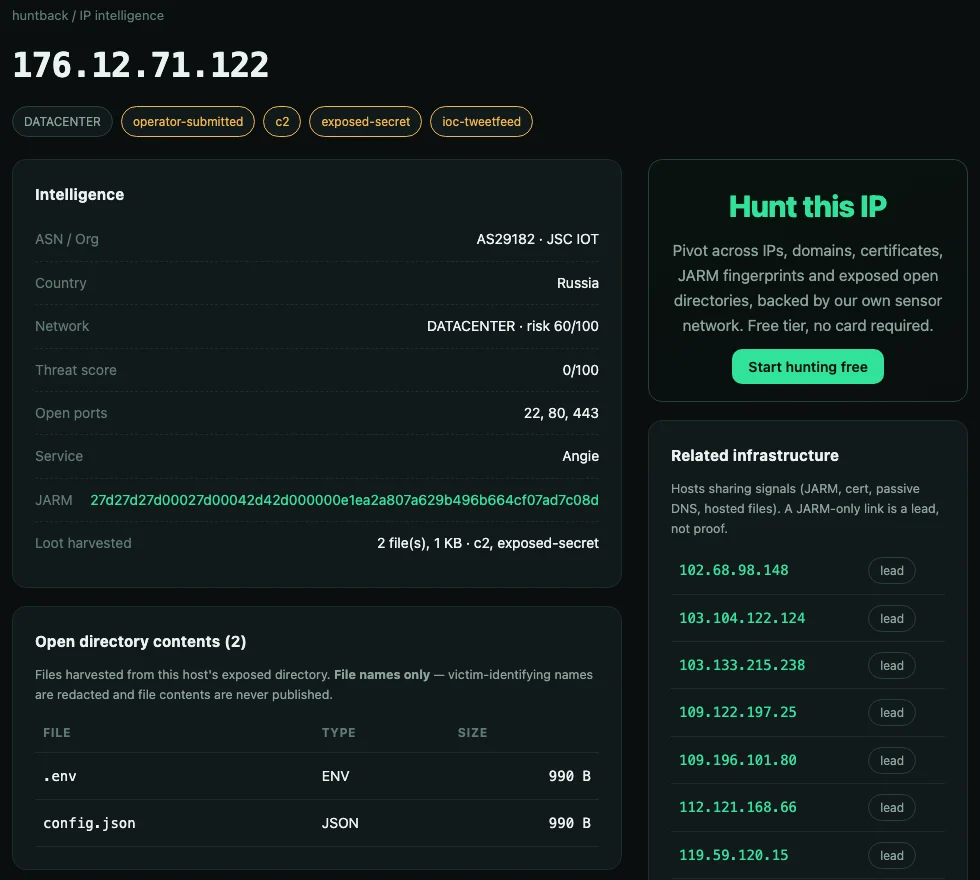
176.12.71[.]122: two 990-byte objects, labelled by the path that was requested. The content tells a different story than the filenames.This is an important analytic distinction. Automated collection systems frequently name recovered content according to the requested path. A response labelled .env may be a real environment file, a denial page, an application shell, or, as in this case, a catch-all redirect. Content must outrank filename during triage.
The false-positive filename does not diminish the find. In this instance, the catch-all behavior exposed something more operationally useful: a stable relationship between an IP, a login workflow, two branded WEB_RAT domains, and a service-worker bootstrap.
Infrastructure reconstruction
The investigation identified two main infrastructure tiers.
Tier 1: operator-facing WEB_RAT panels
On 17 October 2026, four related domains resolved to the same OVH address:
| Domain | Observed IPv4 address | Observed role |
|---|---|---|
webr[.]at | 141.95.112[.]163 | Short redirect/failover domain |
webrat[.]org | 141.95.112[.]163 | Login-panel destination named by the Huntback bootstrap |
webrat[.]es | 141.95.112[.]163 | Alternate panel domain |
webrat[.]uk | 141.95.112[.]163 | Alternate panel domain |
The host presented a Let's Encrypt certificate with:
Subject: CN=webr.at
Not before: 2026-09-14 14:44:04 UTC
Not after:  2026-12-13 14:44:03 UTC
SANs:
  webr.at
  webrat.es
  webrat.org
  webrat.uk
The explicit SAN grouping is stronger than a simple shared-IP observation. It shows that the certificate requester intentionally placed the four names into the same deployment.
ThreatFox separately reported webrat[.]es as a high-confidence SalatStealer indicator and described a CAPTCHA-protected login panel at /login/ on the same OVH address.[8]
Tier 2: C2 and exfiltration infrastructure
The Huntback IP sits in the second tier:
| Domain | Observed IPv4 address | Certificate relationship | Assessed role |
|---|---|---|---|
wruser[.]org | 176.12.71[.]122 | Certificate also names salator[.]es | Current C2/backend and WEB_RAT bootstrap |
salator[.]es | 194.226.98[.]121 | Certificate also names sa1atik[.]cn and websalat[.]top | Backup C2 |
sa1atik[.]cn | No A record during the check | Present on salator[.]es certificate | Dormant or rotated backup C2 |
websalat[.]top | No A record during the check | Present on salator[.]es certificate | Dormant or rotated backup C2 |
The certificate served by wruser[.]org contained:
Subject: CN=wruser.org
Not before: 2026-09-17 17:30:25 UTC
Not after:  2026-12-16 17:30:24 UTC
SANs:
  *.wruser.org
  salator.es
  wruser.org
The certificate served by salator[.]es contained:
Subject: CN=salator.es
Not before: 2026-09-14 16:12:12 UTC
Not after:  2026-12-13 16:12:11 UTC
SANs:
  sa1atik.cn
  salator.es
websalat.topsalator.es appears on both C2 certificates; the captured bootstrap supplies the link from the C2 backend to the panel certificate.The IP behind salator[.]es had changed by the time of this investigation, yet the certificate relationships preserved the link to the other domains. That is exactly why certificate pivots remain useful when operators rotate DNS.
Combined view
/login/; the C2 tier receives stolen data at /sa1at/. The TON record is the route back when the C2 domains stop answering.This role separation is an analytic assessment rather than an architectural diagram recovered from the operators. It is supported by the different domain groups, paths, and sample configurations, but the underlying servers may host additional functions.
Independent malware correlation
The infrastructure map is not based solely on naming conventions.
ThreatFox classified wruser[.]org, salator[.]es, and websalat[.]top as SalatStealer botnet C2 with 100% confidence. The records cite two recent sample hashes and specify /sa1at/ on ports 443 and 992.[3][4]
32db4595652db96810710a1c79ecb11d83acd4a4d8ae661e8a430b64a661e14c
9a26460e4f8605210d681aebf623588644e9db425ae5d8500c24f2af8aadb506
An ANY.RUN-derived observation reported processes from a SolaraV3.zip analysis making repeated TLS connections to 176.12.71[.]122:443. The activity was classified as SalatStealer, providing behavioral support for the IP-level association.[9]
Joe Sandbox recovered multiple SalatStealer configurations containing:
hxxps://salator[.]es/sa1at/
hxxps://wrat[.]in/sa1at/
hxxps://salator[.]ru/sa1at/
hxxps://websalat[.]top/sa1at/
hxxps://salat[.]cn/sa1at/
The exact domain set changes between generations, but the /sa1at/ path remains consistent.[5][10]
This convergence (Huntback content, live DNS, certificate SANs, ThreatFox entries, sandbox traffic, and embedded malware configuration) supports a high-confidence assessment. Any one of those sources could be misleading in isolation; together they form a coherent cluster.
What SalatStealer steals
SalatStealer is also tracked as WEB_RAT. Public analysis describes a Go-based Windows stealer with a broad theft and remote-management feature set.[1][2]
Credential and session theft
The malware targets browser databases and session material, including:
- saved usernames and passwords;
- cookies and authenticated browser sessions;
- autofill and form data;
- Telegram
tdatasessions; - Steam configuration and session information;
- browser-extension storage.
The theft of session tokens is particularly important. A valid session may allow an attacker to access an account without replaying a password and can sometimes bypass the protection expected from multifactor authentication.
Cryptocurrency targeting
Documented versions enumerate installed cryptocurrency applications, wallet databases, browser extensions, private-key material, and configuration files. Public analyses identify targets including MetaMask, Trust Wallet, Coinbase Wallet, Phantom, Exodus, Electrum, Atomic Wallet, Guarda, and numerous other desktop and extension-based wallets.[1][5]
Persistence and defense evasion
Observed persistence mechanisms include Run-key entries and scheduled tasks disguised with familiar names such as:
Lightshot
Procmon
RuntimeBroker
The malware has also been documented adding broad Microsoft Defender exclusions, disabling recovery functionality, checking for virtualized environments, and masquerading in plausible program directories.[1][2]
Remote-control features
The WEB_RAT panel reportedly supports WebSockets, remote PowerShell execution, scripted defense impairment, additional file delivery, real-time interaction, and sharing access to infected systems between subscribers.[1]
The result is broader than a single-pass password stealer. The ecosystem combines credential theft, persistent access, post-compromise tooling, and a commercial control plane.
Resilience before TON
SalatStealer already employed several forms of infrastructure resilience before its blockchain fallback appeared.
Hard-coded backup C2s
Samples carry multiple HTTPS endpoints. If one domain fails, the malware can try another without receiving an updated configuration from the failed server.
Panel-domain failover
CYFIRMA documented scripts that checked multiple WEB_RAT domains for an alive.php response and redirected authenticated users to whichever panel remained available. It also documented cross-domain cookie-transfer behavior intended to preserve panel access during failover.[1]
Multiple network ports
Recent reporting identifies the same /sa1at/ route on standard HTTPS and TCP port 992. Blocking only the default port can therefore leave an alternate path available.[3]
Service workers
The Huntback bootstrap attempts to register /sw.js before redirecting. Service workers can provide legitimate offline and update behavior, but in this context they also give the panel an additional browser-side control point for routing, caching, and application updates. Huntback did not retrieve or analyze the worker body, so its exact purpose remains unconfirmed.
TON as a blockchain dead drop
Recent builds add another layer: TON DNS.
Public static analysis recovered strings directing the malware to queries such as:
hxxps://tonapi[.]io/v2/dns/webratpanel[.]ton/resolve
hxxps://tonapi[.]io/v2/dns/remoteadministratortool[.]ton/resolve
The malware reads the returned record, decodes text representing an IP address, and constructs a new URL:
hxxps://<decoded-address>/sa1at/ThreatFox reported that, at 14:02 UTC on 13 October 2026, the record for webratpanel[.]ton contained the text 168.222.202.171. The associated indicator was therefore:
168[.]222[.]202[.]171:443The sample used to recover this behavior was:
531540654836a5e5add5fe08432bc17c3582c1b0692b411278b1c96a3e5fe8dbRelated TON names documented in public analysis include:
webratpanel[.]ton
remoteadministratortool[.]ton
shyetootval[.]ton
webratxaye1[.]ton
Why this matters
The blockchain is not carrying stolen browser databases or executable payloads in the observations reviewed here. Its function is narrower and more efficient: it publishes a small piece of routing information.
That creates a resilient recovery chain:
The operator can change the record without distributing a new malware build. Defenders can seize or block an individual server, but infected hosts still retain the logic required to discover its successor.
This is not equivalent to an unstoppable C2. Defenders can monitor the TON API path, block known TON names, inspect the follow-on destination, sinkhole conventional infrastructure, and remove the endpoint malware. It does, however, make domain-by-domain blocking an incomplete response.
Timeline
| Date | Observation |
|---|---|
| August 2025 | Public reporting places the first known SalatStealer activity in this period.[2] |
| 5 September 2025 | CYFIRMA publishes a technical analysis of SalatStealer/WEB_RAT, including the panel, /sa1at/, hard-coded fallback domains, WebSockets, persistence, data theft, and MaaS model.[1] |
| 14 September 2026 | Current certificates for the WEB_RAT panel cluster and salator[.]es become valid. |
| 17 September 2026 | The current wruser[.]org certificate becomes valid, linking it to salator[.]es. |
| 20 September 2026 | Additional public reporting connects 176.12.71[.]122 and sa1atik[.]cn to SalatStealer activity through certificate and sandbox evidence.[11] |
| 1 October 2026 | A public sandbox-derived report observes SalatStealer-associated processes communicating with 176.12.71[.]122:443.[9] |
| 11 October 2026 | ThreatFox records the current wruser[.]org, salator[.]es, websalat[.]top, and webrat[.]es indicators.[3][4][8] |
| 13 October 2026 | The TON name webratpanel[.]ton reportedly resolves through its record to 168.222.202[.]171; Huntback also retrieves the WEB_RAT catch-all response under /.env.[6] |
| 14 October 2026 | ANY.RUN records recent SalatStealer activity through this date.[2] |
| 16 October 2026 | Huntback retrieves the latest bootstrap response from 176.12.71[.]122/config.json. |
| 17 October 2026 | Passive DNS and live certificate checks reconstruct the two-tier panel and C2 cluster described in this report. |
Collection time establishes when content was retrievable, not when it was first deployed. DNS and certificate observations also represent a point in time and may change after publication.
Detection and hunting guidance
Network indicators
Organizations should search DNS, proxy, firewall, TLS, and endpoint network telemetry for the following domains:
wruser.org
salator.es
sa1atik.cn
websalat.top
webr.at
webrat.org
webrat.es
webrat.uk
wrat.in
salator.ru
salat.cn
Historical WEB_RAT domains documented in earlier research include:
webrat.in
webrat.ru
webrat.su
webrat.top
posholnahuy.ru
pidorasina.ru
The older domains should be treated as historical hunting pivots rather than assumed-current blocking indicators.
IP indicators
| Indicator | Context | Confidence |
|---|---|---|
176.12.71[.]122 | Huntback bootstrap; current wruser[.]org; publicly observed SalatStealer TLS traffic | High |
141.95.112[.]163 | Current shared host for four WEB_RAT panel domains | High |
194.226.98[.]121 | Current salator[.]es address during this investigation | High as infrastructure; medium as active C2 |
168.222.202[.]171 | Replacement C2 published through TON DNS on 13 October | High historically; revalidate before response action |
Because the cluster rotates infrastructure, domains, certificate relationships, paths, and process behavior will generally be more durable than individual addresses.
High-value URL patterns
/sa1at/
/login/
/alive.php
/api/websocket/servers
/transferCookie.php
/v2/dns/webratpanel.ton/resolve
/v2/dns/remoteadministratortool.ton/resolve
The presence of /login/ alone is not distinctive. /sa1at/, the TON DNS names, and the combination of panel-domain requests are much stronger signals.
Ports
TCP/443
TCP/992
Port 443 is ubiquitous and should only be actioned with destination and path context. Port 992 combined with wruser[.]org or /sa1at/ is substantially more specific.
Endpoint behaviors
Search for:
- executables masquerading as
Lightshot.exe,Procmon.exe, orRuntimeBroker.exeoutside expected vendor paths; - Run keys or scheduled tasks using those names;
- scheduled tasks configured to repeat at unusually short intervals;
- broad Defender exclusions created through
Add-MpPreference; - registry modification disabling Windows recovery or UAC-related controls;
- access to multiple browser SQLite databases followed by archive creation;
- access to Telegram
tdata, Steam configuration, or cryptocurrency wallet locations by an unsigned process; - WMI video-controller queries followed by stealer-like collection behavior;
- requests to TON API immediately followed by direct HTTPS communication with a newly observed IP;
- outbound connections to the same destination on both ports 443 and 992;
- creation of randomly named files in temporary directories immediately before network exfiltration.
ATT&CK mapping
| Technique | Description | Relevance |
|---|---|---|
| T1071.001 | Application Layer Protocol: Web Protocols | HTTPS panel and C2 traffic |
| T1041 | Exfiltration Over C2 Channel | Theft data sent to /sa1at/ infrastructure |
| T1555.003 | Credentials from Web Browsers | Browser password and session database collection |
| T1539 | Steal Web Session Cookie | Authenticated browser-session theft |
| T1547.001 | Registry Run Keys / Startup Folder | Persistence using deceptive executable names |
| T1053.005 | Scheduled Task/Job: Scheduled Task | Repeated execution and persistence |
| T1036.005 | Masquerading: Match Legitimate Name or Location | RuntimeBroker, Procmon, and other familiar names |
| T1497.001 | Virtualization/Sandbox Evasion: System Checks | Video-controller and environment inspection |
| T1562.001 | Impair Defenses | Defender exclusions and related security changes |
| T1105 | Ingress Tool Transfer | Retrieval of auxiliary binaries and scripts |
Indicators of compromise
Current and recently observed domains
wruser[.]org
salator[.]es
sa1atik[.]cn
websalat[.]top
webr[.]at
webrat[.]org
webrat[.]es
webrat[.]uk
TON names
webratpanel[.]ton
remoteadministratortool[.]ton
shyetootval[.]ton
webratxaye1[.]ton
Infrastructure
176[.]12[.]71[.]122
141[.]95[.]112[.]163
194[.]226[.]98[.]121
168[.]222[.]202[.]171
Sample hashes
32db4595652db96810710a1c79ecb11d83acd4a4d8ae661e8a430b64a661e14c
9a26460e4f8605210d681aebf623588644e9db425ae5d8500c24f2af8aadb506
531540654836a5e5add5fe08432bc17c3582c1b0692b411278b1c96a3e5fe8db
Huntback bootstrap hashes
These hashes identify captured web responses rather than executable malware:
bb0863e9a1d61db862d40abaa13ff9cd2261d81ce06d81fd57e57ccaeabfe386
a417f43b1d7f1fdfbb2c5c8babb086155989dcd687518941e7faed46f4fa59b9
What Huntback adds
Earlier research already established that SalatStealer uses the WEB_RAT brand, operates as a commercial stealer, maintains multiple fallback domains, and has incorporated TON-based recovery.[1][6][7]
Huntback adds a current observational layer:
- A live WEB_RAT bootstrap was still being served from the apparent
wruser[.]orgbackend on 16 October. - The bootstrap explicitly linked the short
webr[.]atdomain towebrat[.]org/login/. - Repeated catch-all responses showed that the route remained stable over multiple days and request paths.
- Live certificates connected the captured backend to the current
salator[.]es,sa1atik[.]cn, andwebsalat[.]topC2 cluster. - A separate live certificate grouped four operator-facing WEB_RAT panel domains on the same host.
This is best described as current infrastructure confirmation and expansion, not the first discovery of SalatStealer or its blockchain technique.
Limitations and analytic cautions
- Huntback recovered response content and metadata, not a server filesystem or panel database.
- The
config.jsonand.envnames were requested paths, not evidence that those files existed. - Times-seen values describe Huntback observations and do not measure infections or victims.
- A domain on a certificate establishes administrative or deployment linkage, but does not by itself prove that every named domain performed the same role.
- DNS and hosting assignments can change quickly. IP indicators should be revalidated before takedown or blocking decisions.
- Public sandbox classifications can contain false positives. The assessment relies on convergence across multiple independent evidence types.
- SalatStealer is offered as a service. Infrastructure ownership, malware development, distribution, and individual subscriber activity may involve different people.
- No victim count, geography, or sector targeting can be established from the Huntback capture.
- No login attempt, credential use, victim access, or interaction with the
/sa1at/endpoint was performed.
Conclusion
The 990-byte page recovered by Huntback looked insignificant at first. It was neither a payload nor an exposed database, and its filenames proved misleading. Its value emerged through the pivots around it.
The redirect connected 176.12.71[.]122 to the WEB_RAT login infrastructure. DNS connected the address to wruser[.]org. Live certificates linked that domain to a set of SalatStealer C2 names. Independent malware configurations supplied the /sa1at/ route and backup-domain history. Finally, newer samples showed how the operators can recover from conventional infrastructure disruption by reading a replacement address from TON DNS.
The resulting design is layered rather than exotic: multiple panel domains, multiple C2 domains, alternate ports, service-worker bootstrapping, and a blockchain dead drop. None of those mechanisms makes the infrastructure invulnerable. Together, however, they make reactive single-indicator blocking far less effective.
For defenders, the practical lesson is to hunt the recovery chain, not just the current server. The most durable opportunities are the /sa1at/ path, TON API lookups for the known names, abnormal scheduled-task and Defender-exclusion behavior, and the transition from a blockchain resolution request to direct HTTPS communication with a fresh IP.
For researchers, the Huntback observation shows why apparently low-value web artifacts deserve careful content analysis. A false-positive .env can still expose the redirect that binds a live malware service together.
References
- CYFIRMA: Unmasked: Salat Stealer
- ANY.RUN: SalatStealer malware profile
- ThreatFox: wruser.org
- ThreatFox: salator.es
- Joe Sandbox: Salat Stealer configuration
- ThreatFox: SalatStealer TON fallback C2
- RT-Solar: Blockchain dead drops, including WEB_RAT/SalatStealer
- ThreatFox: webrat.es
- AbuseIPDB: sandbox-derived report for 176.12.71.122
- Joe Sandbox: additional Salat Stealer configuration
- CTX Threat News: Salat Stealer infrastructure correlation